 Store Hours & Locations
 Reserve Rentals
 Contact Us

Snowboard Size Chart & Calculator
Find The Right Board Size
What Size Snowboard Do I Need?
Use our snowboard size calculator to get a personalized recommendation based on your weight, height, boot size, ability, and riding style. Then check the snowboard size chart to confirm the right length and width.
The calculator shows your best all-around size, plus shorter and longer options for playfulness, stability, and float. Always confirm your result against the manufacturer’s rider weight range.
Need more detail? Jump to the complete snowboard size guide for width, flex, stance, rentals, and common sizing mistakes.
Snowboard Size Calculator
The middle choice for the best mix of stability and maneuverability.
More stability, edge hold and float.
Quicker turns and a more maneuverable feel.
Compare two sizes
FAQ quick tips
Is a longer snowboard more stable?
Yes. A slightly longer board increases stability, float and edge hold. Shorter boards feel quicker and more playful.
What size should beginners choose?
Beginners often prefer boards that are 1 to 2 cm shorter because they are easier to maneuver and more forgiving.
What size should advanced riders choose?
Advanced and expert riders often size at or slightly above the middle size for added control and confidence.
Should I size up so a child can grow into it?
Do not size up too much. A board that is too big makes first turns harder and can slow progression.
Quick Snowboard Sizing Tips
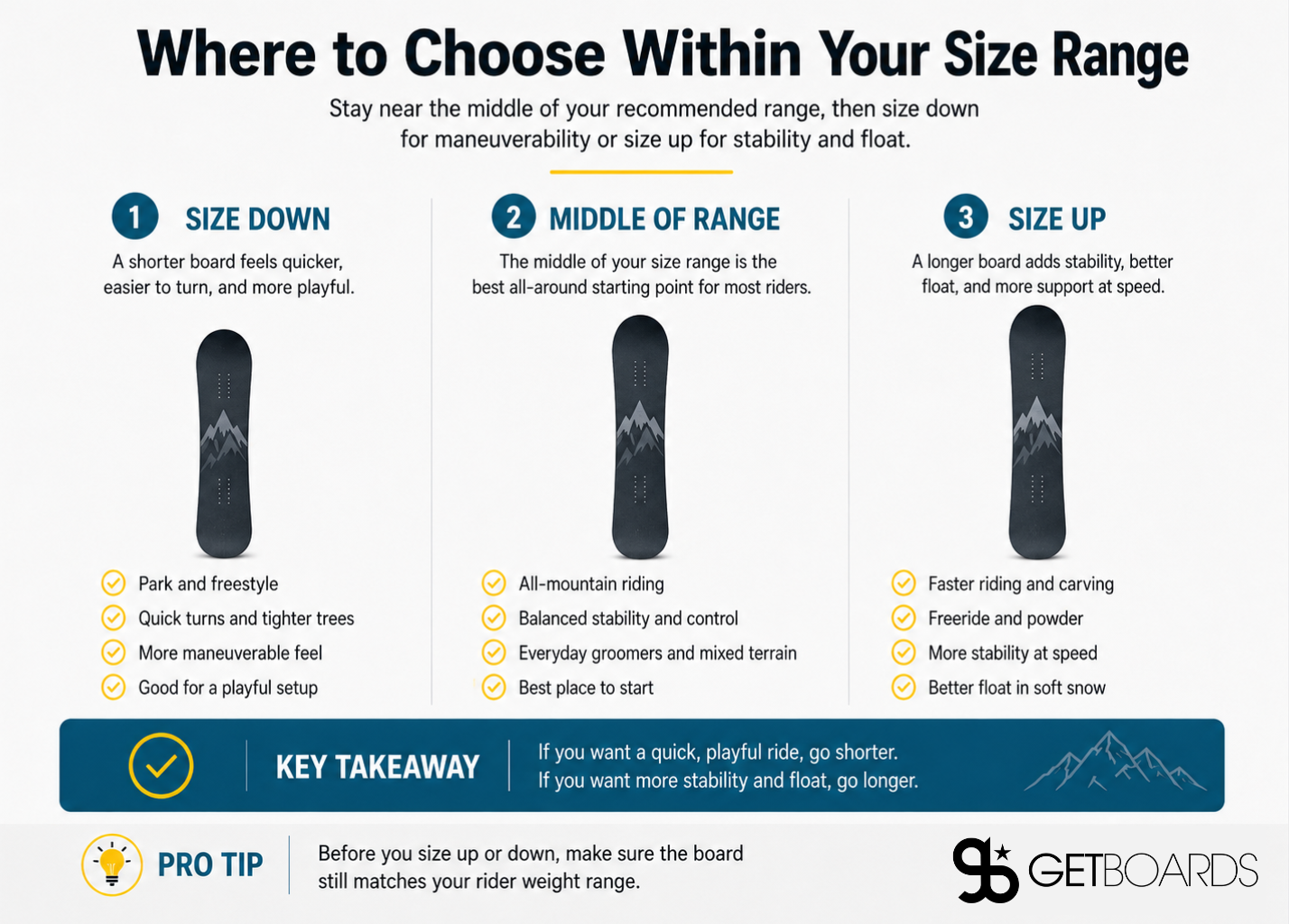
A slightly shorter board generally feels quicker and easier to turn. A slightly longer board generally provides more stability, edge hold, and float. When you want one board for groomers, park laps, trees, and the occasional pow day, the middle of the recommended range is usually the safest starting point.
Adults Snowboard Size Chart
Use this snowboard size chart for a quick starting point based on your current weight. Height, ability, riding style, board shape, flex, and boot size can all shift the best choice within the range. Use the calculator above for a more personalized recommendation.
Tip: Choose the shorter end for easier turns, beginner progression, trees, or park laps. Choose the longer end for more stability, carving, speed, and float in softer snow.
| Weight (lb) | Weight (kg) | Snowboard Size (cm) |
|---|---|---|
| Under 100 | Under 45 | 137–143 |
| 95–110 | 43–50 | 140–145 |
| 105–120 | 48–54 | 142–147 |
| 115–130 | 52–59 | 144–149 |
| 125–140 | 57–64 | 146–151 |
| 135–150 | 61–68 | 148–153 |
| 145–160 | 66–73 | 150–155 |
| 155–170 | 70–77 | 152–157 |
| 165–180 | 75–82 | 154–159 |
| 175–190 | 79–86 | 156–161 |
| 185–200 | 84–91 | 158–163 |
| 195–210 | 88–95 | 160–165 |
| 205–220 | 93–100 | 162–167 |
| 215–230 | 98–104 | 164–169 |
| 225+ | 102+ | 165+ |
How Snowboard Sizing Works
How to Use the Snowboard Size Chart
- Find your current weight range.
- Note the recommended snowboard lengths.
- Check whether your snowboard boot needs a regular or wide board.
- Adjust within the range for ability and riding style.
- Confirm the manufacturer’s rider weight range for the exact model.
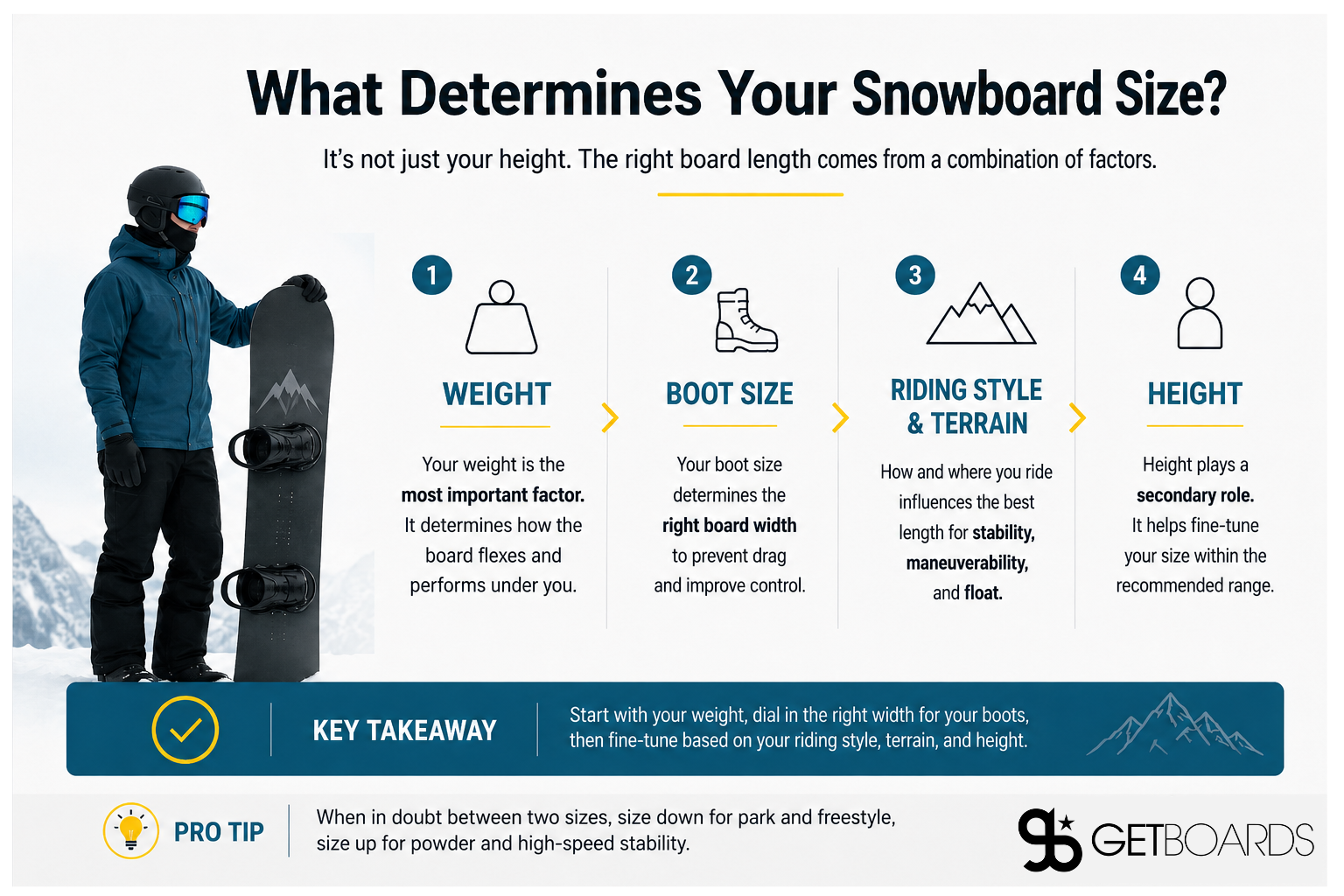
Start With Rider Weight
Weight matters most because a snowboard is designed to flex within a rider weight range. Your weight loads the board when you start a turn, hold an edge, land or ride through chopped snow.
If you are too light for a board, it may feel stiff, slow to respond, and difficult to bend into a turn. If you are too heavy for it, the board may bend more than intended, feel unstable at speed, and lose support during aggressive turns or landings.
Do I Need a Wide Snowboard?
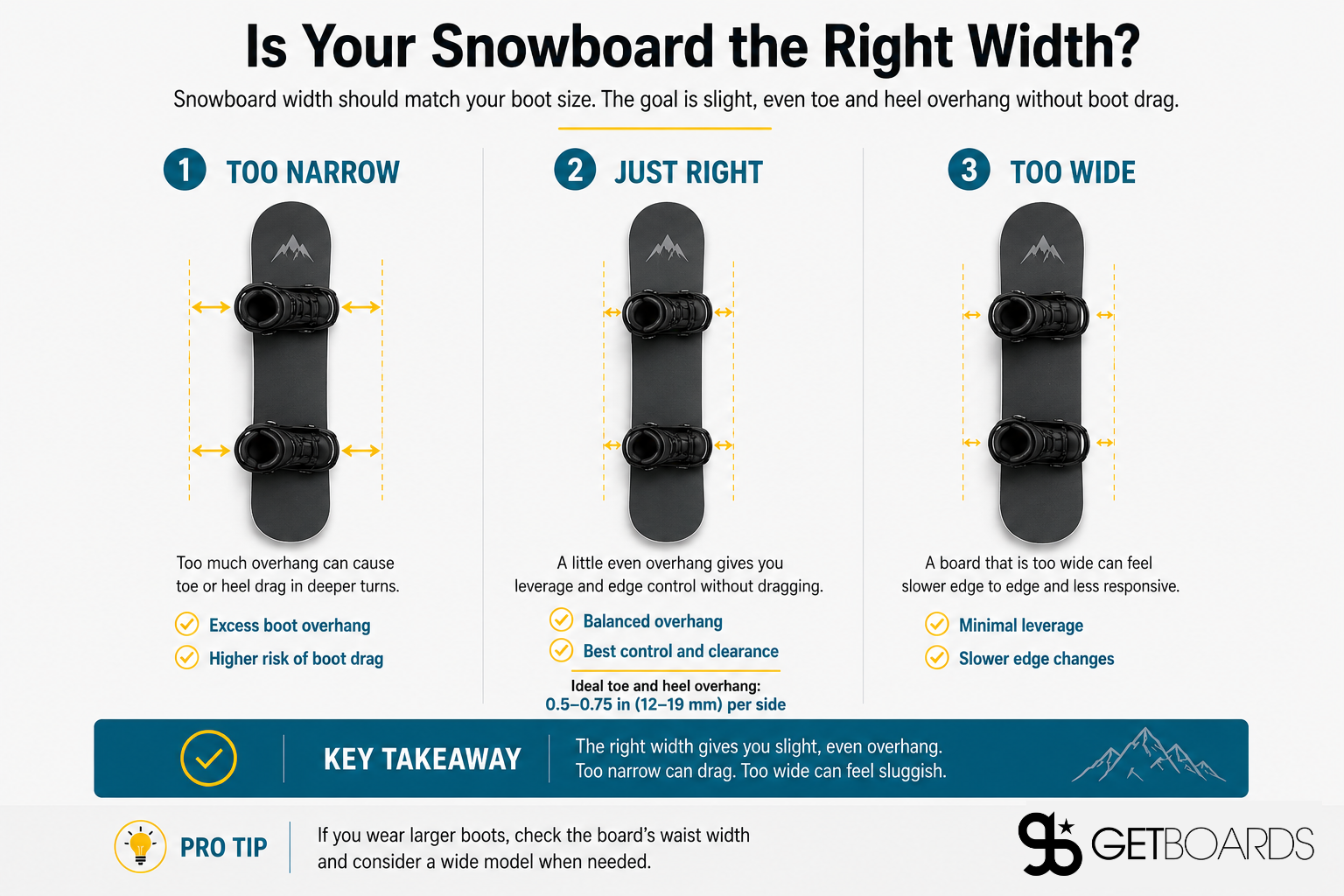
Signs Your Snowboard Is Too Narrow
- Your toes or heels extend far beyond the edges.
- Your boots touch the snow during hard turns.
- You unexpectedly lose an edge while carving.
- You cannot lean the board over without boot drag.
Signs Your Snowboard Is Too Wide
- Edge changes feel slow.
- The board takes extra effort to roll onto an edge.
- The setup feels less reactive than expected.
- You have very little boot overhang on either side.
A small and reasonably even amount of toe and heel overhang helps create leverage. Binding angles, boot profile, and how high the boot sits above the board can also change clearance. Browse current snowboards at Getboards and check the snowboard waist width chart below.
Snowboard Width & Boot Size Chart
Boot size controls board width, not snowboard length. Your toes and heels should have enough leverage over the edges without hanging so far over that they touch the snow during a deep turn. Boot outsole length varies by brand, so use this as guidance and check the actual waist width of the board.
| Men US | Women US | UK | EU | Minimum Waist Width | Sizing Guidance |
|---|---|---|---|---|---|
| 10 | 11.5 | 9 | 44 | 25.9 cm / 259 mm | Wide guidance begins |
| 10.5 | 12 | 9.5 | 44.5 | 26.1 cm / 261 mm | Wide guidance |
| 11 | 12.5 | 10 | 45 | 26.3 cm / 263 mm | W size label begins |
| 11.5 | 13 | 10.5 | 45.5 | 26.5 cm / 265 mm | W |
| 12 | 13.5 | 11 | 46.5 | 26.7 cm / 267 mm | W |
| 12.5 | 14 | 11.5 | 47 | 26.9 cm / 269 mm | W |
| 13 | 14.5 | 12 | 47.5 | 27.1 cm / 271 mm | W |
| 13.5 | 15 | 12.5 | 48 | 27.3 cm / 273 mm | W |
| 14 | 15.5 | 13 | 48.5 | 27.5 cm / 275 mm | W |
| 14.5 | 16 | 13.5 | 49 | 27.8 cm / 278 mm | W |
Kids and Youth Snowboard Size Chart
Kids should be sized for their current height, weight, and ability, not for the size they might reach next season. A board that is clearly too large can make first turns harder and slow progression. Use the calculator above for a more personalized kids recommendation.
| Age | Height (ft/in) | Height (cm) | Weight (lb) | Weight (kg) | Snowboard Length (cm) |
|---|---|---|---|---|---|
| 3 | 3'1" | 94 | 34 | 14 | Under 80 |
| 4 | 3'4" | 102 | 37 | 16 | 80–90 |
| 5 | 3'7" | 109 | 42 | 18 | 85–95 |
| 6 | 3'9" | 114 | 46 | 21 | 90–100 |
| 7 | 3'11" | 119 | 50 | 23 | 95–105 |
| 8 | 4'2" | 127 | 57 | 26 | 100–109 |
| 9 | 4'5" | 135 | 63 | 29 | 105–119 |
| 10 | 4'7" | 140 | 70 | 32 | 110–125 |
| 11 | 4'9" | 145 | 79 | 36 | 115–129 |
| 12 | 4'11" | 149 | 89 | 41 | 125–135 |
| 13 | 5'2" | 156 | 100 | 46 | 130–145 |
| 14 | 5'5" | 164 | 112 | 51 | 140–149 |

How to Choose a Kids Snowboard Size
If choosing between a board that is slightly small and one that is clearly too large, the slightly smaller board is usually easier for a child to control.
Also check the child’s current boot size, whether the bindings adjust correctly, whether the stance width feels natural, and whether the board is designed for the child’s weight.
Do not use age by itself. Children of the same age can have very different heights, weights, boots, and riding experience. A child who is already linking turns may use more of the range than a first-day rider.
Jump to a Section of Our Snowboard Size Guide
Adjust for Riding Style & Terrain
All-Mountain Snowboard Sizing
For groomers, mixed snow, occasional powder, and some park laps, start near the middle of your recommended range. This gives you a useful balance of maneuverability and stability.
Freestyle and Park Snowboard Sizing
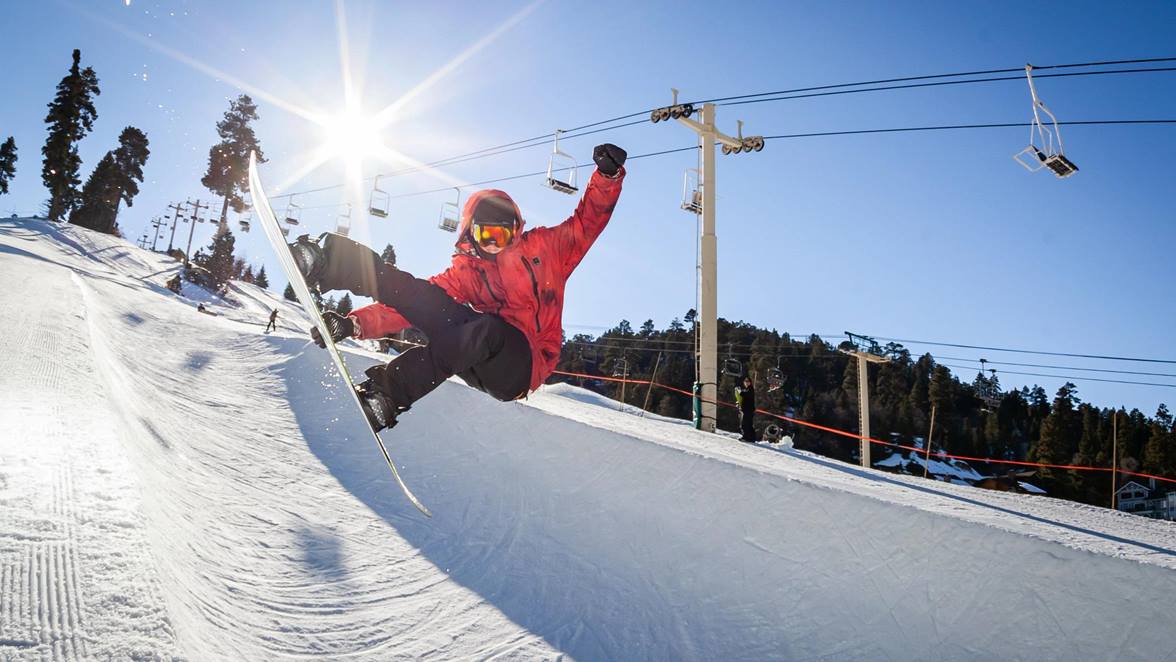
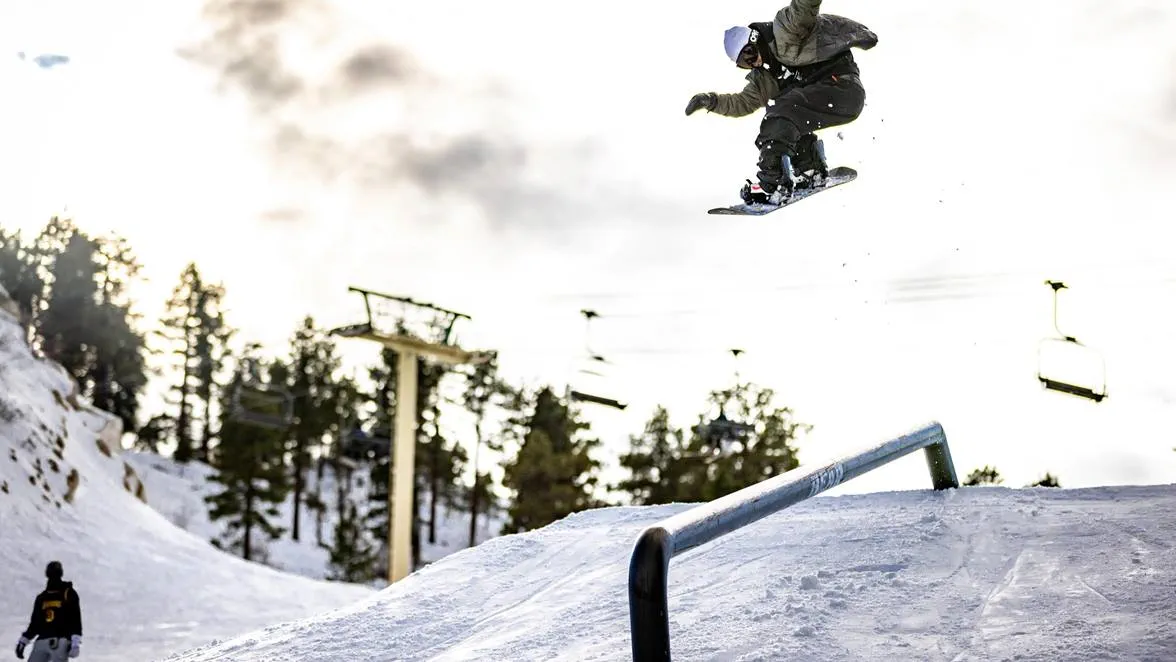
Park riders commonly choose toward the shorter end. A shorter board can feel easier to spin, press, and move through rails or tight features. Riders hitting larger jumps may stay closer to their normal size for more landing support.
Freeride Snowboard Sizing
Freeride riders often choose their recommended size or move slightly longer. More length can add stability, edge hold, and support at speed, but directional shapes and firmer flex patterns can already make a board feel more powerful.
Powder and Tree Sizing
A longer traditional board can add surface area and float on a pow day. Volume-shifted powder boards use extra width, taper, and setback to create float in a shorter length, so follow the model-specific chart. In tight trees, the shorter end of the range can feel quicker and easier to redirect.
What Length Snowboard Do I Need?
Beginner
Beginners usually benefit from the shorter end of the recommended range. A board around 1 to 2 cm shorter than the neutral recommendation can feel easier to maneuver while learning edge changes and linked turns. Do not buy a clearly oversized board just to grow into it.
Intermediate
Intermediate riders generally do well near the middle of the range. At this point, terrain and riding style become more important. A progressing carver may move slightly longer, while someone learning park may stay slightly shorter.
Advanced and Expert
Advanced riders often choose near the middle or longer end for edge hold, stability, and control. Experienced riders may also deliberately size down for park, tight trees, or a surf-style powder shape. The difference is that they understand the tradeoff and choose it for a specific reason.
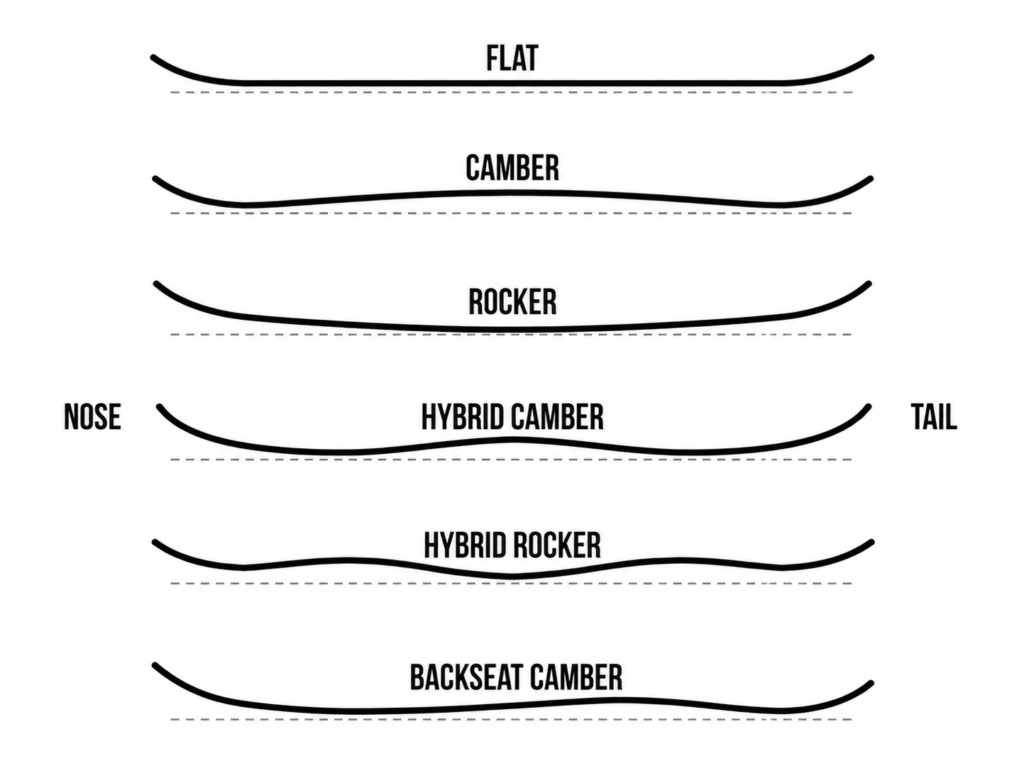
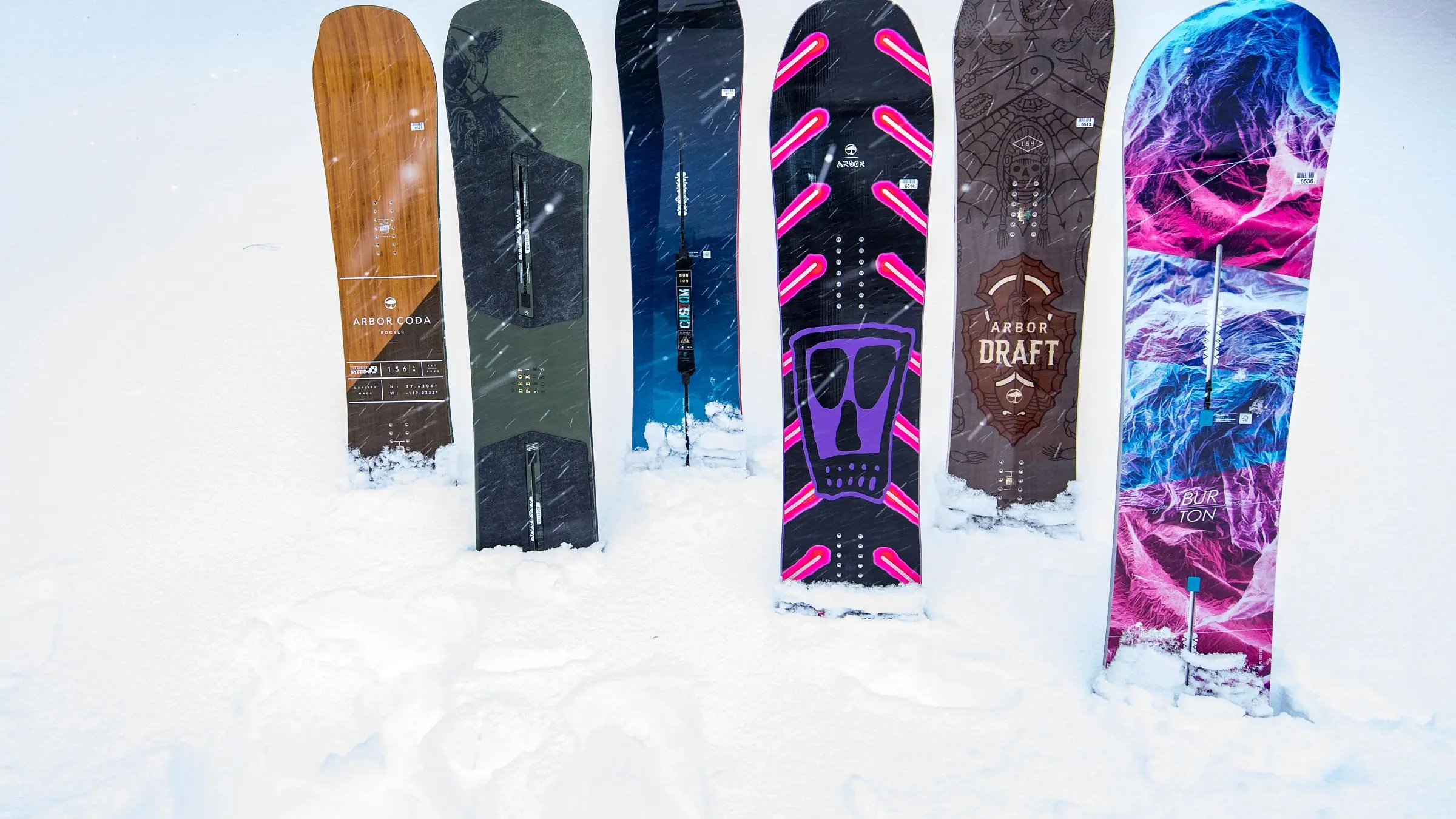
Camber vs. Rocker Snowboards vs. Directional and Volume Shifted Snowboards
Two snowboards of the same length can feel completely different.
Camber
Camber generally provides a more engaged edge and a locked in feel. These boards are commonly ridden close to the manufacturer’s standard size recommendation.
Rocker
A rocker-dominant board may feel looser and easier to pivot. Some riders feel that it rides shorter than a camber board with the same listed length.
Directional Shapes
Directional boards are designed to perform best with one end leading. Width, taper, setback, effective edge and flex may change how the listed length feels.
Volume-Shifted Snowboards
Volume shifted boards move more surface area into width, which often lets the rider choose a shorter length without losing as much float.
How Snowboard Flex and Size Work Together
Softer Snowboards
- Easier to flex and turn at slower speeds.
- More forgiving for beginners.
- Popular for playful riding and park laps.
- Often easier for lighter riders to control.
Stiffer Snowboards
- More supportive at speed.
- Better suited to aggressive carving and freeride terrain.
- More demanding to bend and control.
- Can feel too powerful for a lightweight or newer rider.
Flex ratings are not standardized across every snowboard company. A 5 out of 10 from one brand may not feel exactly like a 5 from another. Read the intended use and rider weight range rather than choosing from the number alone.
Should You Size Up or Down?
Choose Toward the Shorter End When You Want
- Easier turn initiation.
- Quicker movement in trees.
- A more playful feel.
- Easier spins and presses.
- A more manageable beginner setup.
Choose Toward the Longer End When You Want
- More stability at speed.
- Additional edge hold.
- More float in soft snow.
- More support through variable terrain.
- A stronger platform for carving or larger landings.
When both sizes support your weight and suit your boots, the smaller option favors agility. The larger option favors stability. The middle is usually the cleanest all-around choice.
Common In-Between Size Questions
What if You Are Between Two Snowboard Sizes?
Overlapping weight ranges are normal. Check whether both sizes support your weight, whether one provides a better waist width for your boot, and whether you prefer quicker turns or more stability. Park and tree riders often choose the smaller option. Freeride and carving focused riders often choose the larger one.
Is a 160 cm Snowboard Too Big?
A 160 cm board is not automatically too big. It can make sense for a heavier rider, someone who wants more stability, or someone riding a traditional freeride shape. It may feel too big when the rider cannot flex it, struggles to start turns, or falls below the model’s recommended rider weight.
What Size Snowboard for a 200 Pound Rider?
Start with the adult chart and look at the model’s weight range. A rider near 200 pounds commonly lands around the upper 150s to 160s depending on the exact board, boot size, terrain, and desired feel. Do not choose from weight alone when the model is unusually wide, stiff, tapered, or volume shifted.
Does Height Matter for Snowboard Sizing?
Height is a secondary factor in snowboard sizing. Start with your weight because it determines how the board flexes, then use height to choose between two compatible lengths or find a comfortable stance width.
What Size Snowboard for a 5’2″ Rider?
A 5’2″ rider will generally fit a snowboard between 139 and 150 cm, depending on weight, ability, boot size, and riding style. Choose toward the shorter end for easier turns and park riding, or the longer end for more stability and float.
What Size Snowboard for a 5’8″ Rider?
A 5’8″ rider will generally fit a snowboard between 148 and 162 cm. Lighter riders and beginners will usually fall near the shorter end, while heavier or more aggressive riders may prefer the longer end.
What Size Snowboard for a 5’10” Rider?
A 5’10” rider will generally fit a snowboard between 150 and 162 cm. The best size depends more on rider weight than height, so confirm that the exact board supports your weight before choosing a length.
Women’s Snowboard Sizing
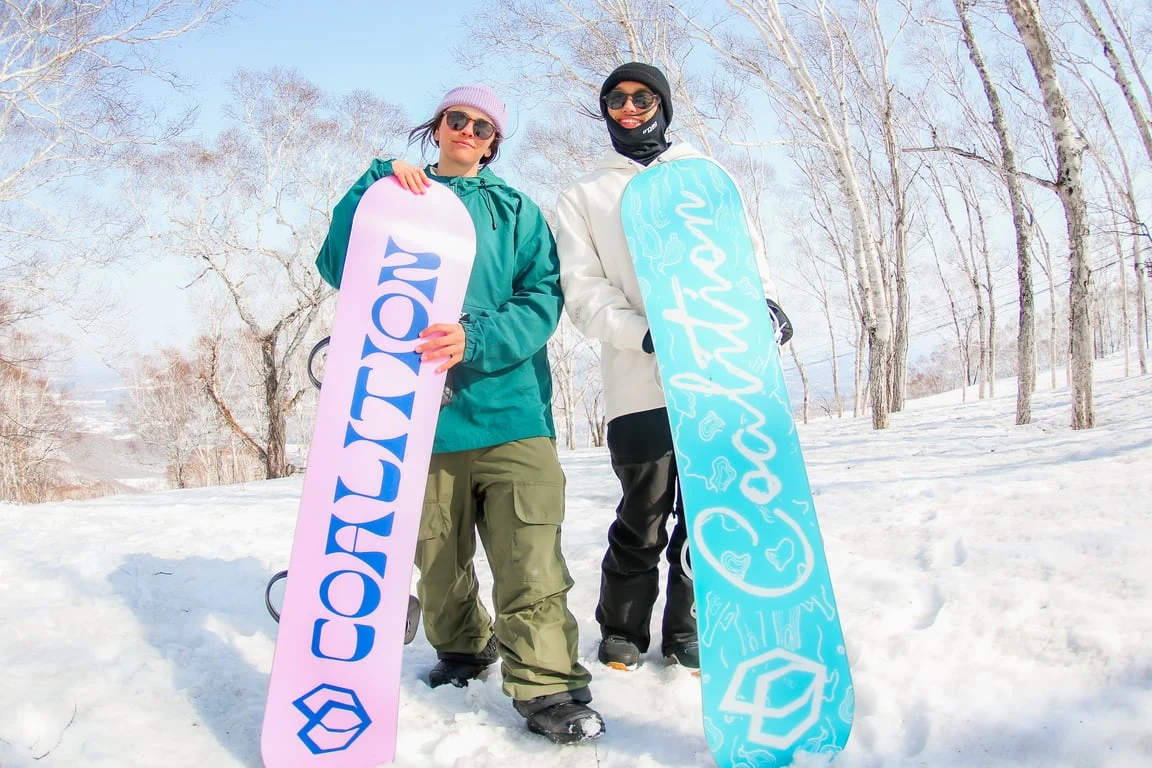
Women’s snowboard sizing should still begin with actual weight and boot size. Women’s models often come in narrower widths, shorter lengths, and different flex patterns. That can be helpful for riders with smaller boots or lower body weights.
The label on the board is less important than whether its specifications fit the rider. Some women ride men’s or unisex boards, and some smaller riders find a women’s model easier to flex and move from edge to edge.
Enter your actual measurements into the calculator, then check the rider weight and waist width for the exact snowboard.
How to Know if Your Snowboard Is the Wrong Size
Signs a Snowboard May Be Too Long or Too Stiff
- It is difficult to initiate turns.
- The board feels slow or planky.
- You struggle to flex it.
- Low-speed riding feels unnecessarily demanding.
- It pulls you through turns instead of responding to your input.
Signs a Snowboard May Be Too Short or Too Soft
- It feels nervous or unstable at speed.
- It bends too easily under your weight.
- The edge washes out during aggressive turns.
- It lacks support during landings.
- It does not provide enough float for your terrain.
Before replacing the board, also check binding centering, stance, boot fit, edge condition, and whether the flex is the real problem.
Stance Width and Brand Differences
Snowboard Size and Stance Width
Board length and stance width are related, but they are not interchangeable. A longer snowboard often provides a wider range of insert positions, which may help a tall rider. Buying a board that is too long only to gain stance width can create control problems.
Your stance should feel balanced and natural. Do not force an uncomfortable position to make the wrong board work. If a board supports your weight but cannot provide a comfortable stance, try another size or model.
Do Snowboard Brands Size Differently?
Yes. Two boards with the same listed length can feel different because of effective edge, waist width, sidecut, flex, rocker, camber, taper, setback, and overall shape. Use this guide to identify a starting range, then check the specifications for the exact model.
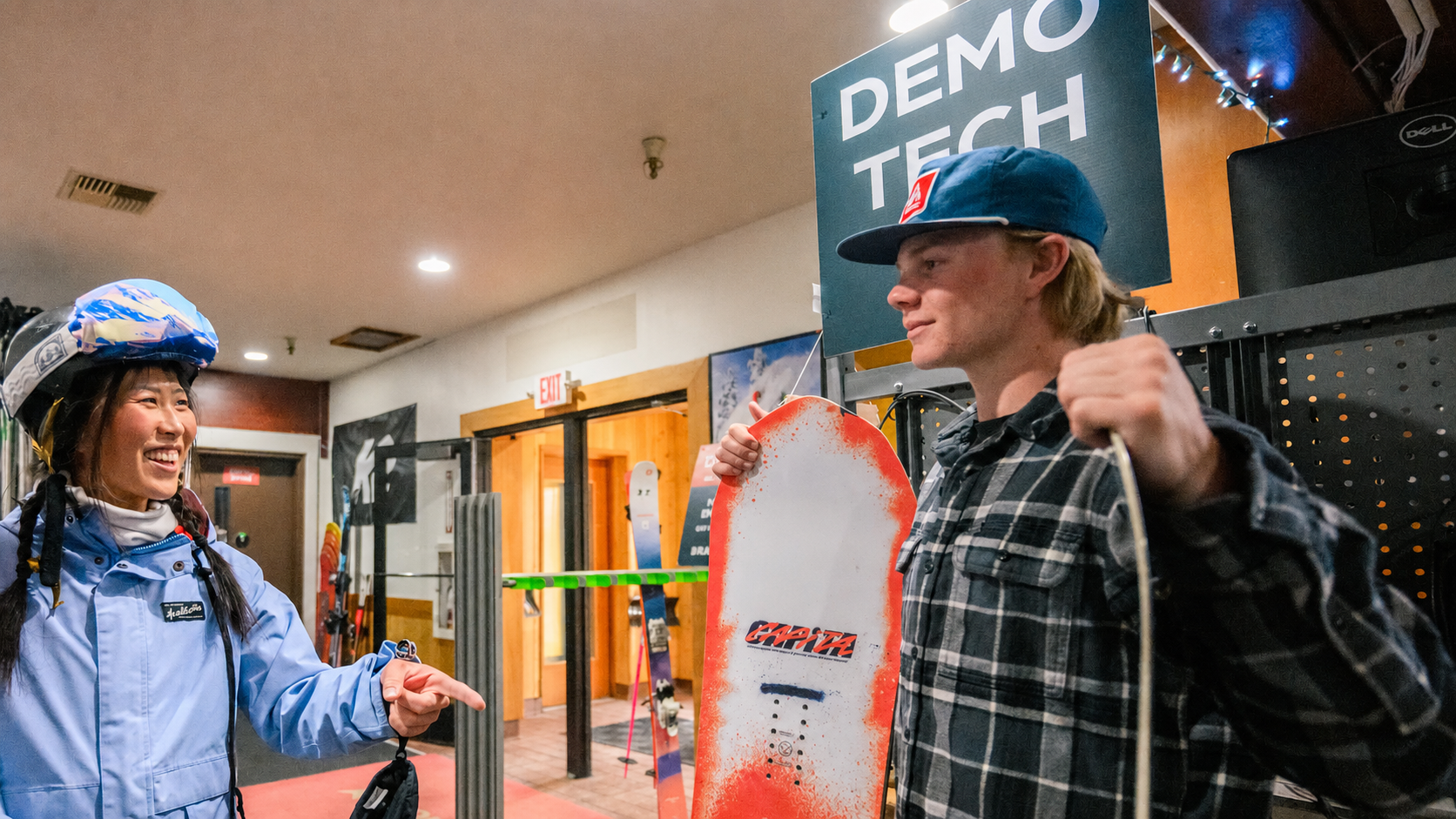
Rental Snowboard Sizing
What Size Snowboard Should a Beginner Rent?
A beginner generally does well near the shorter end of a suitable weight range. The board should feel manageable when starting turns without being so short or soft that it becomes unstable.
Why a Shop Might Recommend a Different Snowboard Size?
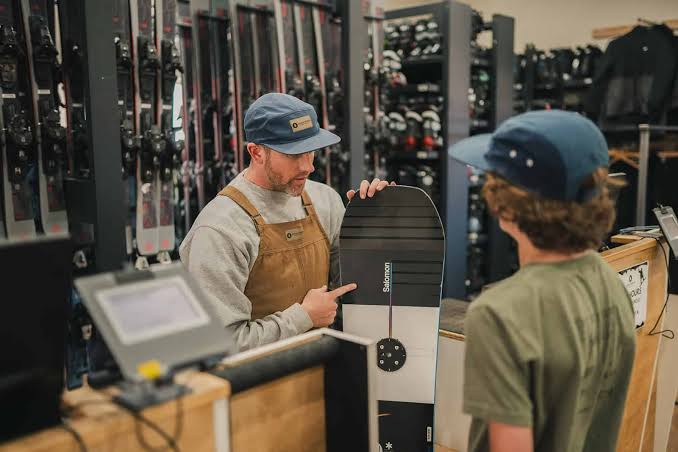
Size charts are a starting point. A shop may adjust your recommendation based on the day’s snow conditions, your ability level, and where you plan to ride. A playful park setup may run shorter, while a freeride board built for speed and float may be longer.
How to Tell if a Rental Board Is the Wrong Size
Return to the shop if the board is extremely difficult to turn, the boots drag heavily, the bindings cannot be centered, the stance feels painful, or the setup feels unstable at moderate speed. Do not fight a poor setup all day.
See the Big Bear snowboard rental options at Getboards for complete setups fitted before you head to the mountain.
Common Snowboard Sizing Mistakes
01
Choosing Only by Height
Height can provide context, but weight has a stronger effect on how the board flexes.
02
Ignoring the Manufacturer’s Weight Range
A general snowboard size chart cannot account for every snowboard construction, flex pattern, and shape.
03
Buying Too Large for a Beginner
More length does not automatically mean better value or faster progression.
04
Ignoring Boot Size
The right length with the wrong width is still the wrong snowboard.
05
Assuming Every Wide Board Is the Same
Waist width varies by brand, model, and length. Double check the actual measurement in the product specs.
06
Copying Another Rider’s Setup
A friend’s board may suit their weight, boots, terrain, and preferences but not yours.
07
Buying for a Future Weight
Choose a snowboard that works for your current body and current riding.
08
Confusing Length With Flex
A shorter stiff board may be harder to control than a slightly longer soft board.
Rental & Demo Sizing
Should You Rent or Test Before Buying?
A calculator and chart can narrow your options, but riding the board tells you how its shape, flex, and width feel under your feet. Testing is especially useful when you are between two sizes, considering a volume-shifted board, moving to a stiffer setup, or comparing regular and wide models.
What to Tell a Snowboard Shop
- Your current weight and normal shoe size.
- Your snowboard boot size if you already own boots.
- Your honest riding level.
- The terrain you ride most often.
- Whether you want quicker turns, more stability, or more float.
- The exact two sizes or models you are comparing.
That information gives the fitter much more to work with than height alone. For help with a specific setup, contact our shop or visit the Getboards Help Center. Check out the latest snowboards available to try before you buy in our Demo Center.

Snowboard Size Calculator FAQs
Quick answers to the most common questions about snowboard length, width, flex, and riding style.
Is weight more important than height?
Yes. Weight is generally the best starting point because it determines how much load the rider places on the board. Height can help with stance and choosing between compatible sizes.
How accurate is a snowboard size calculator?
A calculator can provide a practical starting range when it includes weight, boot size, ability, style, and height. It cannot fully account for every board’s flex, shape, and manufacturer recommendations.
Is a shorter snowboard easier to ride?
A slightly shorter board is normally easier to turn and maneuver. Going too short can reduce stability, support, and float.
Is a longer snowboard more stable?
A slightly longer board generally provides more stability, edge hold, and surface area. It can also require more effort to turn.
What size should a beginner get?
Beginners usually do well near the shorter end of a suitable weight range. Around 1 to 2 cm shorter than the neutral recommendation may feel easier to control.
Do I need a wide snowboard?
You may need a wide or mid-wide board when your boots create excessive overhang on a regular-width model. Check the actual waist width, boot outsole, and binding angles.
How much boot overhang is acceptable?
A small and reasonably even amount of toe and heel overhang creates leverage. The exact clearance depends on boots, bindings, angles, board width, and how deeply you carve.
Can I ride a snowboard that is too big?
You may be able to ride it, but a board far above your appropriate size or weight range can feel difficult to flex, slow to turn, and unforgiving.
Can I ride a snowboard that is too small?
You may be able to ride it, but an undersized board can feel less stable and may be overpowered by the rider.
Should park riders use a shorter snowboard?
Many park riders choose slightly shorter for easier spins, presses, and quick movement. Riders hitting large jumps may prefer their normal size for more landing support.
Should powder riders use a longer snowboard?
A longer traditional board may add float, but volume-shifted powder boards are often designed to be ridden shorter. Follow the sizing instructions for the exact shape.
Does flex change the size I need?
It can. A lightweight rider may find a stiff board difficult to control even when the length appears correct. A heavier or aggressive rider may overpower a soft board in the same length.
Do kids need room to grow into a snowboard?
Do not substantially oversize a child’s board for future growth. A board that is too large can make learning more difficult.
Find Your Snowboard Size
Start with the calculator, confirm the result with the adult or kids chart, and then check the width recommendation for your boots.
- Use your current weight.
- Enter your real snowboard boot size.
- Be honest about your ability.
- Select the terrain you actually ride.
- Check the exact manufacturer size chart.
- Choose shorter for playfulness or longer for stability only when both sizes support your weight.
Still stuck between two boards? Contact Getboards and our team can help you narrow it down.
Have Questions?
Our Experts Can Help
Have Questions?
Our Experts Can Help